
2.2. Cathode Materials 101
The Effect of Cathode Material Choice on Cell KPIs
Lithium-ion batteries (LiBs) have several key performance indicators (KPIs), which can be grouped into the following interlinked categories: energy density (gravimetric and volumetric), power capability, lifetime (stability), safety (thermal stability), and cost. The cathode material and electrode strongly influence these KPIs, and cathode material evolution has been shaped by a constant balancing act across them. Common commercial cathodes include nickel-cobalt-manganese oxide blends (NCM) and iron-based materials (LFP, LMFP).
No material has ever maximised all five simultaneously, as shown in Figure 1. Instead, each generation reflects a set of trade-offs driven by the application requirements at that time in history. Early development prioritised energy density, driven by the needs of portable electronics. However, as applications expanded into e-mobility and stationary storage, thermal stability, degradation behaviour, affordability, and supply chain resilience emerged as equally critical design constraints. Regarding cost, in BEVs, the battery pack typically accounts for around 30–40% of total vehicle cost, while cathode active material (CAM) is generally the largest single contributor to cell cost. Cathode chemistry selection therefore influences not only battery performance, but also overall vehicle economics.
Competition amongst CAM suppliers and cell producers is tightening, but a growing range of applications beyond EVs and BESS, including drones, humanoid robots, eVTOL, automated guided vehicles (AGVs), and autonomous mobile robots (AMRs), offers new opportunities for cathode suppliers and battery manufacturers.
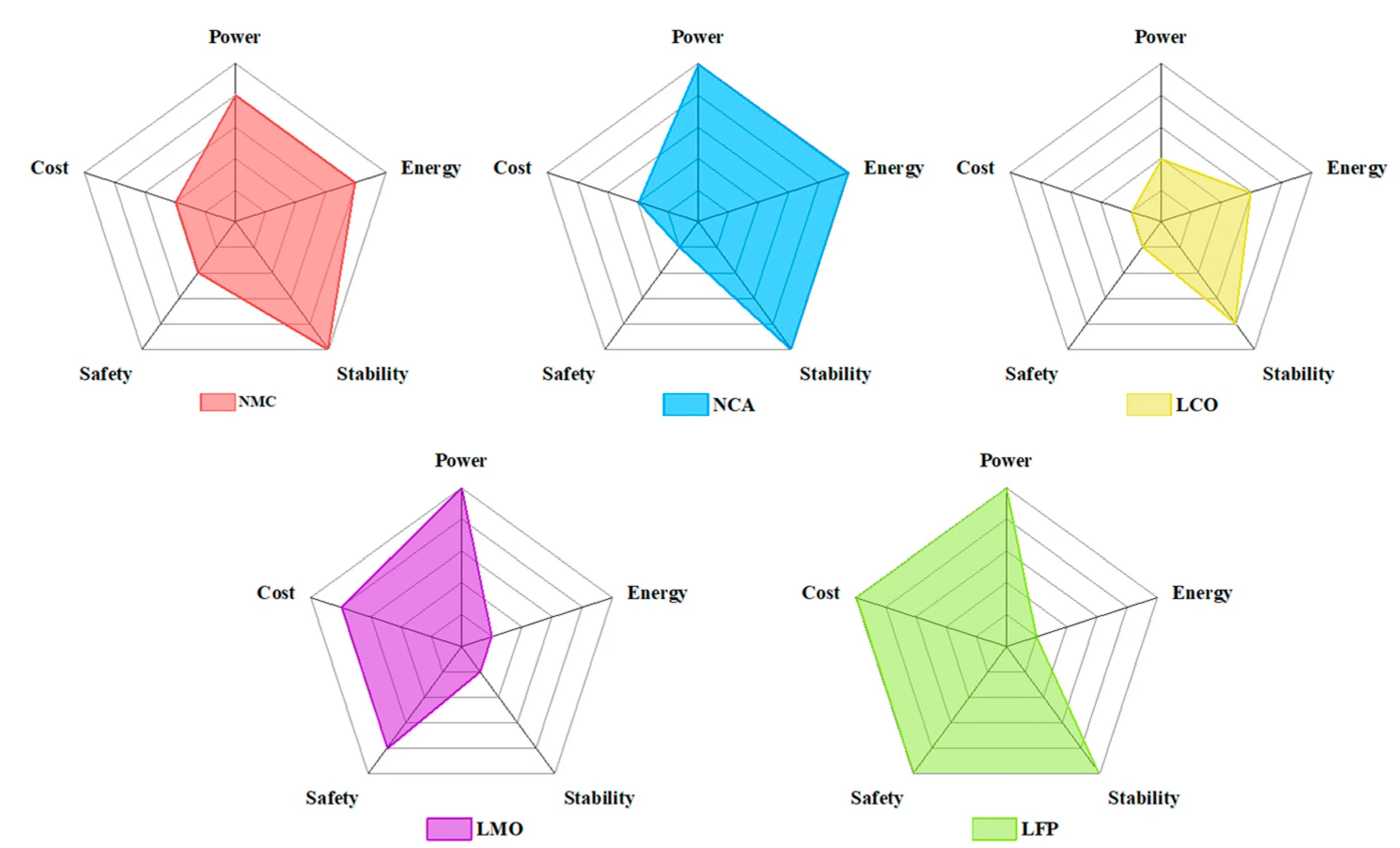
Figure 1. General comparison of common lithium-ion cathode chemistries across key downstream cell KPIs. Higher values indicate stronger relative performance.
Cathode Materials & Synthesis Routes
LiB cathode materials are classified by their crystal structures and associated electrochemical characteristics. The main families are:
Layered oxides (NCM, NCA, LCO)
Spinel systems – (LMO)
Polyanionic frameworks (LFP, LMFP)
These are illustrated in Figure 2. The structural and chemical features of the material influence:
Redox thermodynamics (how readily redox-active atoms in the cathode gain or lose electrons as Li⁺ ions are inserted or removed, which helps determine cell voltage)
Li⁺ diffusion kinetics (how quickly Li⁺ ions can move through the cathode particles during charge and discharge)
Degradation mechanisms (unwanted chemical or structural changes that occur over repeated cycling that reduce cell capacity and power).
In addition to crystal structure, synthesis methodology plays a critical role in determining particle morphology, crystal phase purity, defect chemistry, and electrochemical performance. Common production approaches include high-temperature solid-state synthesis, co-precipitation, sol-gel processing, and hydrothermal methods.
Key synthesis parameters such as calcination temperature, precursor chemistry, particle size distribution, and surface modification (e.g., coatings or doping) directly influence Li⁺ diffusion pathways, interfacial stability, and long-term degradation behaviour. Two materials with the same nominal chemical formula can therefore perform very differently if their particle structures, impurity levels, surface chemistries or defect concentrations differ.
Key synthesis parameters such as calcination temperature, precursor chemistry, particle size distribution, and surface modification (e.g., coatings or doping) directly influence Li⁺ diffusion pathways, interfacial stability, and long-term degradation behaviour. Two materials with the same nominal chemical formula can therefore perform very differently if their particle structures, impurity levels, surface chemistries or defect concentrations differ.
The preferred route depends strongly on the cathode chemistry. Layered oxides such as NCM and NCA are commonly produced from co-precipitated transition-metal hydroxide precursors, which are subsequently mixed with a lithium source (usually lithium carbonate or hydroxide) and calcined at high temperature. High-Ni NCM materials prefer lithium hydroixde and an oxygen-rich calcination temperature.
LFP has traditionally relied on comparatively conventional solid-state processing, including precursor blending, milling, carbon addition and high-temperature calcination. These routes are scalable and cost-effective, but can offer less control over particle uniformity, morphology and compaction behaviour. Gen 4 LFP typically uses more advanced solid-state or wet-chemical processing, with tighter control of precursor purity, particle-size distribution, carbon coating, doping and calcination. The aim is to achieve higher compaction density, improved capacity, stronger rate capability and more consistent material performance.
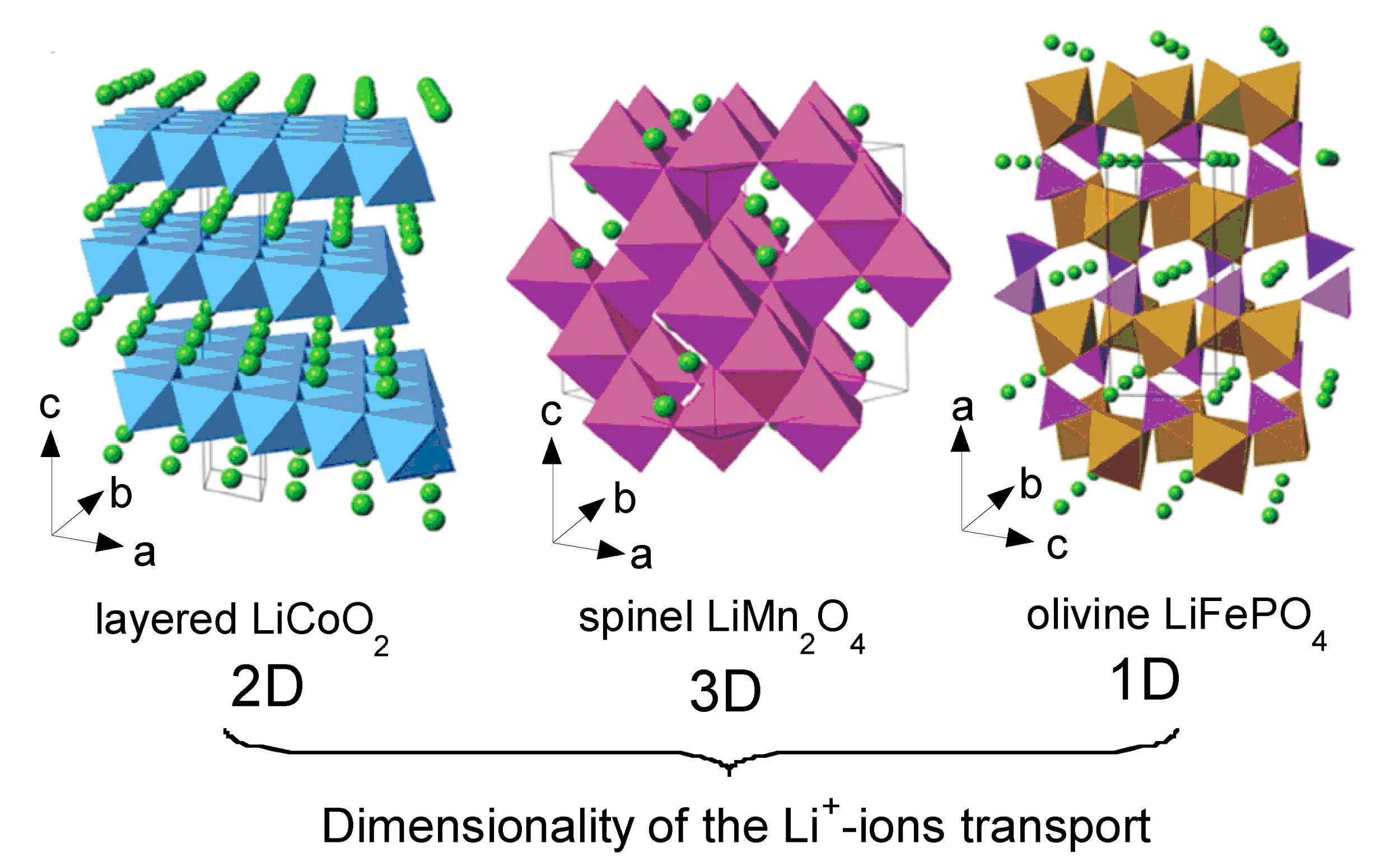
Figure 2: Overview of lithium-ion cathode crystal structures. Green spheres represent Li⁺ ions. In layered LiCoO₂, blue represents CoO₆ octahedra; in spinel LiMn₂O₄, purple represents MnO₆ octahedra; in olivine LiFePO₄, gold represents FeO₆ octahedra and purple represents PO₄ tetrahedra. The dimensionality of each material is based on the main Li⁺ diffusion pathways inside the solid material particles. Greater diffusion dimensionality supports higher intrinsic rate capability, although practical power performance also depends on factors such as diffusion coefficients, electronic conductivity, particle size and electrode design.
Layered Oxides
Layered oxides such as lithium cobalt oxide (LCO), LiCoO₂, and lithium nickel manganese cobalt oxide (NCM-xyz), NiₓCoᵧMn𝓏, operate through two-dimensional lithium intercalation between transition metal oxide slabs. These materials are typically synthesised via solid-state or co-precipitation methods followed by high-temperature calcination (700-1000°C), which determines crystallinity and cation ordering. These systems enable high theoretical capacities, with LCO reaching up to 274 mAh g⁻¹. However, practical utilisation remains constrained to ~140-160 mAh g⁻¹ under a 4.2 V cutoff due to structural instability at high states of delithiation. Charging beyond this threshold induces irreversible phase transitions, lattice distortion, oxygen release, and electrolyte decomposition. Particle size reduction and surface coatings can partially mitigate these effects but increase surface reactivity and parasitic reactions. This inherent instability is captured Figure 2 through reduced safety and moderate cycle life.
In layered NCM cathodes, changing the relative proportions of nickel, manganese and cobalt alters the balance between the main cell KPIs. The composition name reflects the approximate transition-metal ratio: for example, NCM-811 contains approximately 80% Ni, 10% Co and 10% Mn. Because each element introduces different benefits and trade-offs, the final composition is selected according to the requirements of the target application. A simplified version of this is shown in Figure 3.
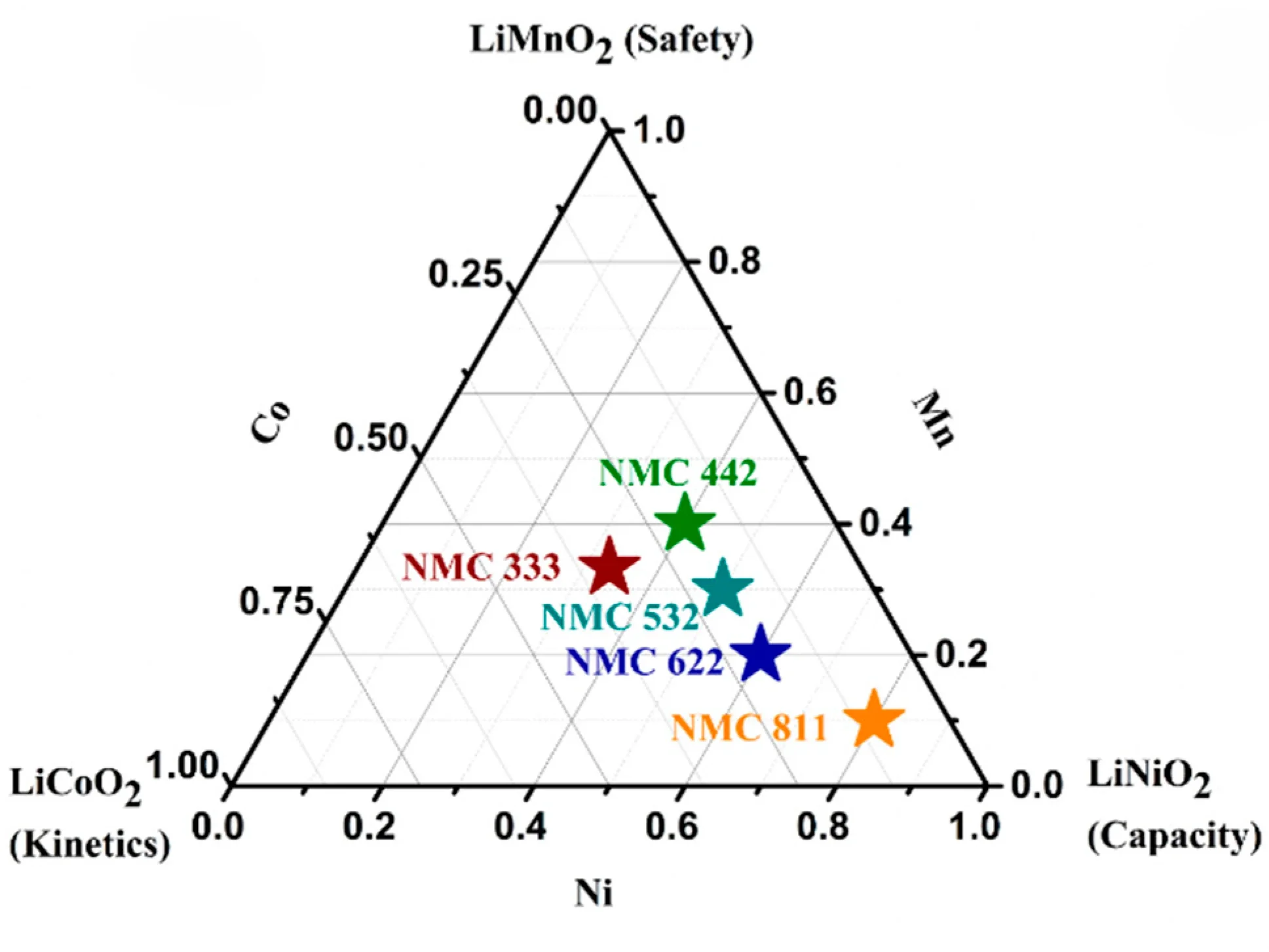
Figure 3. Ternary composition diagram showing representative Ni–Co–Mn ratios in NCM cathode materials. The selected composition depends on the requirements of the target application. In general, increasing Ni raises capacity and energy density but reduces thermal stability and tends to accelerate degradation. Increasing Co generally supports power capability and cycle life by helping maintain the layered structure, but increases cost and ESG concerns. Increasing Mn generally improves thermal safety, lowers cost and can support cycle life, but reduces energy density because Mn⁴⁺ contributes relatively little usable capacity and may also limit power capability. These trends are qualitative and depend on the overall composition, material design, processing and operating conditions.
A Note on Safety
Battery safety depends on many factors beyond cathode chemistry, including cell design, manufacturing quality, electrolyte formulation, thermal management, the BMS and pack-level protection. Here, safety refers specifically to material-level thermal stability: how resistant the charged cathode is to structural breakdown and lattice-oxygen release when heated. In general, the more strongly oxygen is stabilised within the cathode lattice, the greater the material-level thermal stability.
In highly charged NCM cathodes, structural decomposition and lattice-oxygen release commonly become significant at approximately 200–250°C (Ko et al., 2025), although the exact temperature depends on composition, state of charge and material design. Reported oxygen-release onsets include approximately 220°C for NCM-811 and 250°C for NCM-523, with higher-Ni compositions generally becoming unstable at lower temperatures. Mn4+ helps stabilise the oxygen framework, so increasing Mn at the expense of Ni generally improves thermal stability, although it reduces usable capacity and energy density.
By comparison, LFP’s olivine phosphate structure holds lattice oxygen much more strongly through its P–O bonds and remains stable to much higher temperatures. LFP cells can still enter thermal runaway because the electrolyte and other cell components can react at lower temperatures, but the cathode releases far less oxygen and heat than NCM.
Higher nickel content generally increases specific capacity and energy density because nickel provides most of the usable redox capacity. However, Ni-rich materials are more reactive at high states of charge and are more susceptible to Li/Ni cation mixing, oxygen release, lattice expansion and contraction, particle cracking, all contributing to accelerated degradation. This makes thermal stability, cycle life and manufacturing control more challenging. Increasing. Replacing cobalt with nickel can reduce material cost, although Ni-rich cathodes often require more tightly controlled production and protective coatings, which can increase manufacturing cost.
Higher manganese content generally improves structural and thermal stability. In conventional NCM, manganese is predominantly present as stable Mn⁴⁺, which helps reinforce the oxygen framework but contributes relatively little usable capacity. Increasing Mn at the expense of Ni therefore tends to reduce energy density and may reduce electronic conductivity and rate capability, although it can lower cost and improve safety.
Higher cobalt content promotes an ordered layered structure, reduces detrimental Li/Ni mixing and supports electronic conductivity, reaction kinetics and cycling stability. Its disadvantages are high cost, concentrated supply chains and significant environmental and social sourcing concerns. Replacing capacity-contributing nickel with cobalt can also reduce achievable specific capacity.
Figure 3 presents a general simplified overview: Ni primarily supports capacity, Mn primarily supports safety and structural stability, and Co primarily supports kinetics and structural ordering. In practice, these roles overlap, and performance also depends heavily on particle design, synthesis conditions, coatings, dopants and operating voltage.
The push toward higher energy density led to nickel-rich compositions such as NCM-811 and NCA (nickel cobalt aluminium oxide, with typically >80% Ni), enabling cell-level energy densities approaching 250–300 Wh kg⁻¹, supporting extended EV driving ranges of ~600–650 km. These materials are commonly prepared using controlled co-precipitation to achieve uniform nickel distribution, followed by calcination under oxygen-rich atmospheres to stabilise the layered structure. However, increasing nickel content introduces significant challenges: cation mixing (Ni²⁺ migration into Li layers), surface reconstruction, and micro-crack formation during cycling. These microstructural defects expose fresh reactive surfaces, accelerating electrolyte decomposition and forming resistive NiO-like phases, which increase impedance growth.
More critically, these materials exhibit reduced thermal runaway thresholds. Under abuse conditions such as internal short circuits, high-nickel cells can reach temperatures exceeding 900°C, leading to catastrophic failure. Even advanced mitigation strategies, including surface coatings, doping, and electrolyte additives such as triallyl phosphate, only partially suppress these reactions and often introduce trade-offs such as increased interfacial resistance and reduced power capability. These limitations are reflected in the diagram, where gains in energy density are offset by compromises in safety, cost, and lifecycle stability.
Spinel Systems
Spinel systems such as lithium manganese oxide, LiMn₂O₄ (LMO), offer three-dimensional lithium diffusion pathways, enabling high power capability and strong rate performance. These materials are synthesised via both solid-state and hydrothermal routes, with the latter providing improved control over particle size and crystallographic orientation. However, their performance is strongly affected by temperature and electrolyte interactions. Manganese dissolution, particularly above 55°C, leads to deposition on the anode, loss of active material, and rapid capacity fading.
In ideal spinel LMO, Mn has an average oxidation state of +3.5, corresponding approximately to a mixture of Mn³⁺ and Mn⁴⁺. The Mn³⁺ fraction is susceptible to Jahn–Teller distortion and disproportionation into Mn⁴⁺ and soluble Mn²⁺, making manganese dissolution a particularly important degradation mechanism in LMO (Lu et al. 2014). By contrast, Mn in conventional layered NCM is predominantly present as stable Mn⁴⁺, so Mn³⁺ disproportionation and dissolution are generally much less severe, although some transition-metal dissolution can still occur under aggressive conditions (Aryal et al. 2021).
Efforts such as doping and surface coatings improve stability but add complexity without fully resolving the degradation mechanisms, resulting in limited cycle life in demanding applications. Despite extensive advances in synthesis optimisation, compositional tuning, and surface engineering, both layered and spinel cathodes remain fundamentally constrained by intrinsic structural and thermodynamic instabilities. Improvements in one performance axis particularly energy density consistently introduce penalties in safety, cost, or long-term durability.
Polyanionic Frameworks
LFP, based on a polyanionic framework, offers a fundamentally different stability paradigm. LFP crystallises in an orthorhombic olivine structure (space group Pnma), where lithium ions occupy channels that support predominantly one-dimensional transport along the [010] direction. The structure consists of corner-sharing FeO₆ octahedra and PO₄ tetrahedra, forming a robust three-dimensional framework. The inductive effect of the polyanionic PO₄³⁻ group raises the Fe²⁺/Fe³⁺ redox potential to ~3.4 V vs Li⁺/Li, while simultaneously strengthening the lattice through highly stable P-O covalent bonds. In a cell containing a graphite anode and LFP cathode, this corresponds to a nominal operating voltage of approximately 3.2 V. This framework strongly resists lattice collapse and oxygen release, contributing to substantially better thermal stability than many layered oxides, particularly at high states of charge.
From a compositional standpoint, LFP follows a 1:1:1 stoichiometric ratio (Li:Fe:P), offering excellent chemical stability. Careful compositional and defect control remains important because lithium deficiency, antisite defects, and secondary phases can obstruct its one-dimensional lithium-transport pathways. Though its tolerance to slight compositional variation is wider compared to nickel-rich layered oxides (NCM, NCA), which require strict compositional control and are prone to cation mixing and surface reconstruction.
Commercial variants of LFP primarily arise from materials-engineering strategies rather than bulk compositional changes, including carbon-coated LFP (LFP/C), aliovalent doping (Mg, Ti, Nb), and nano-structuring. Its derivative, LMFP, partially substitutes Fe with Mn, introducing a higher-voltage Mn²⁺/Mn³⁺ redox plateau near 4.0–4.1 V in addition to the Fe²⁺/Fe³⁺ plateau near 3.4 V. This increases the nominal operating voltage and practical capacity (~170 mAh g⁻¹), thereby bridging the gap toward higher energy density while retaining olivine stability.
Layered oxide battery materials such as LCO, NCM, and NCA, rely on close-packed oxygen frameworks and exhibit higher electronic conductivity (~10⁻³ S cm⁻¹) and faster lithium diffusion (~10⁻¹⁰ cm² s⁻¹). Despite its structural advantages, pristine LFP exhibits intrinsically low electronic conductivity (~10⁻⁹ S cm⁻¹) and relatively slow lithium diffusion (10⁻¹⁴-10⁻¹⁶ cm² s⁻¹) due to its one-dimensional transport pathways (which are vulnerable to channel-blocking defects), significantly lower than layered and spinel counterparts. However, these limitations have been largely overcome through particle size reduction, conductive carbon coating, morphology and defect control, and optimised synthesis routes such as solid-state reactions, hydrothermal synthesis, and sol-gel methods, enabling practical capacities of 150-170 mAh g⁻¹ and competitive rate capability.
As reflected in the dataset, modern LFP achieves competitive practical capacity and rate capability to other commercial layered oxide cathodes while maintaining superior thermal stability and cycle life.
Next, we will look at the history of LFP development.